

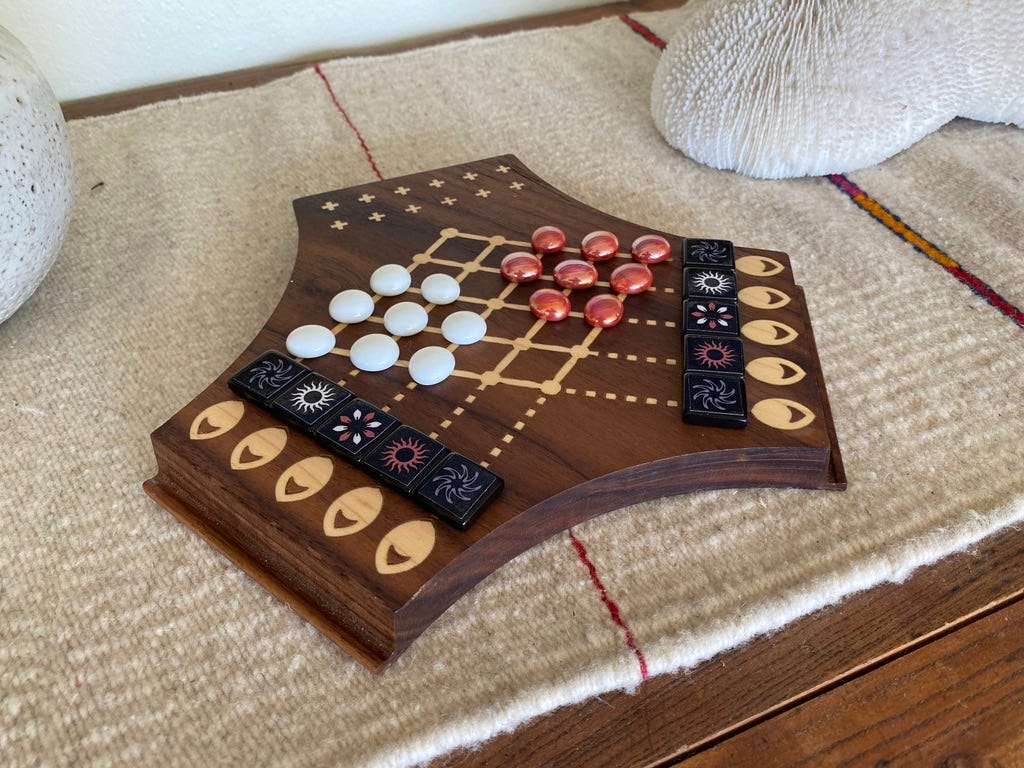
What is Sneaky Town?
Sneaky Town is game in which two players compete to capture three objectives (known as “charms”) on a 5x5 grid. The catch is that neither knows exactly where the charms are — positions depend on private information that’s split between the players.
Sneaky Town is easy to learn and hard (or even impossible) to master, with quick rounds that encourage “just-one-more / run-it-back” type play, placing it close in feel to some card games (like rummy 500, spades, or cambio1), while retaining the simple elegance of a classic abstract-strategy game. And with it’s hidden information, Sneaky Town is prone to hilarious reveals and upsets — a lively time for players of all skill levels, in casual play and tournaments alike!
Read on for:
Gameplay (at a glance) (includes link to rulebook)
Want Sneaky Town updates? Subscribe here for updates, and fill out the Sneaky Town Interest Form to be notified if/when sets are for sale:
Gameplay (at a glance)
Players compete in quick, back-to-back rounds. Each round players shuffle their personal set of five black tiles, placing them in their rack so that only they know the order:
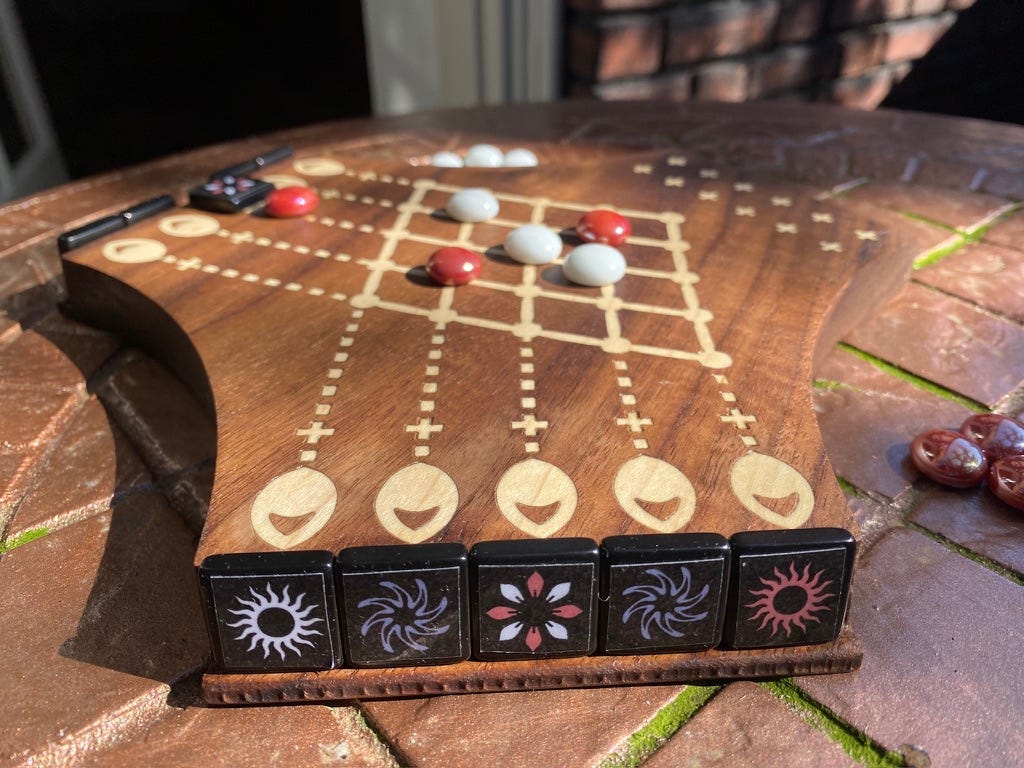
Then players take turns placing stones of their color (Red or White) on intersections in the central lattice, aiming for any of the three secret charm locations.
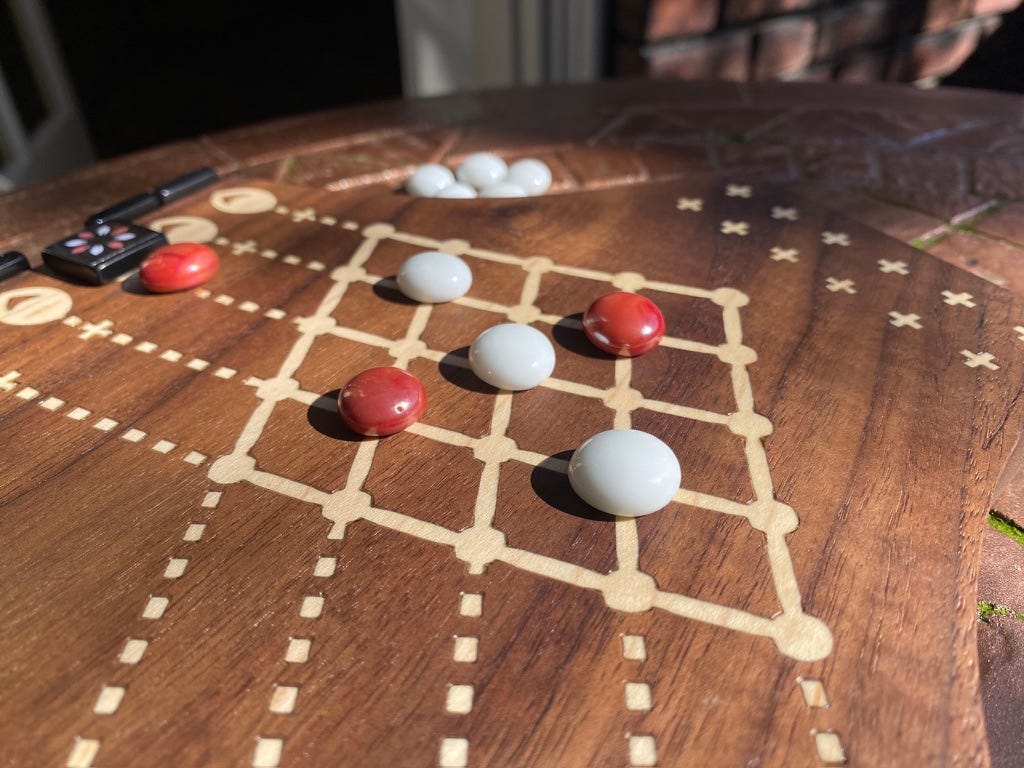
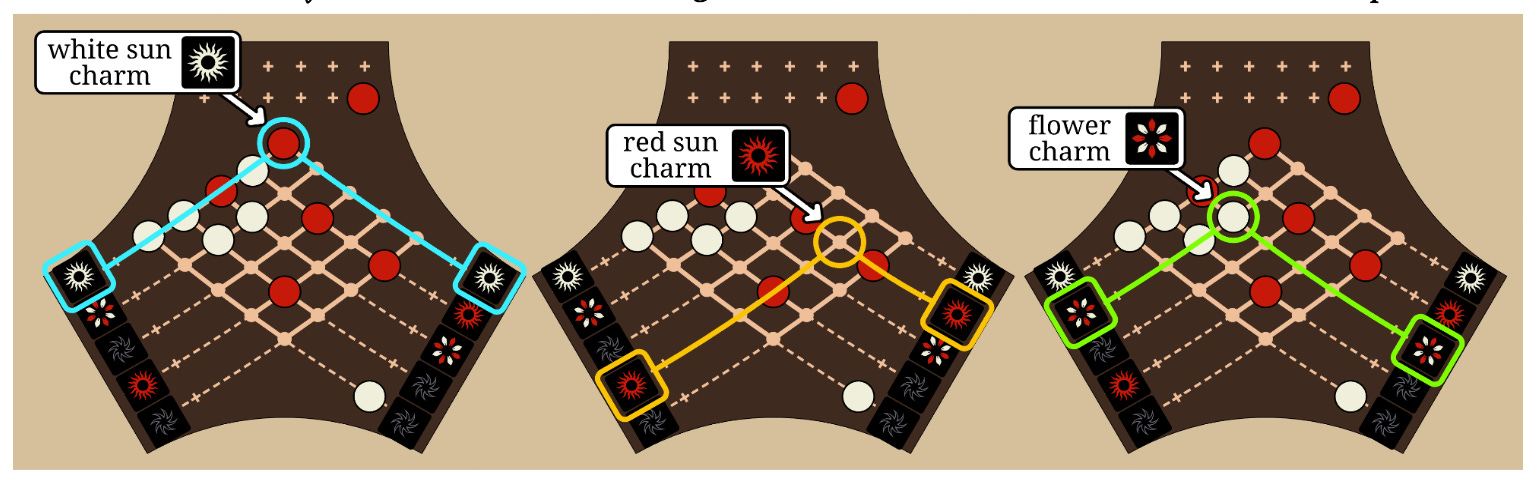
Charm locations depend on the order of both players’ tiles, and are only made evident at the round’s end when all tiles are revealed. Locations are determined by tracing from matching tiles to their point of intersection. The image below illustrates this “tracing” concept, showing, for a particular round, the locations of each charm: the white sun, the red sun, and the flower (circled in turquoise, orange, and lime green respectively):
While a players’ primary aim is to claim intersections and secure points, they don’t need to claim a new intersection every turn, and instead can choose from a short list of actions (including reveals, swaps, and relocations). This lets players balance between coverage (claimed intersections), information (via revealed tiles), and reserve (held-back stones that provide later-game advantages).

Strong players will also aim to infer tile positions from their opponents’ actions, and to obscure their own positions as they play.
Here are the full rules, including a brief discussion of strategy:
If you just want to know how to play, then you’re done! Read on for the game’s development status.
State of development
Sneaky Town began seven years ago and is now on its fourth iteration:
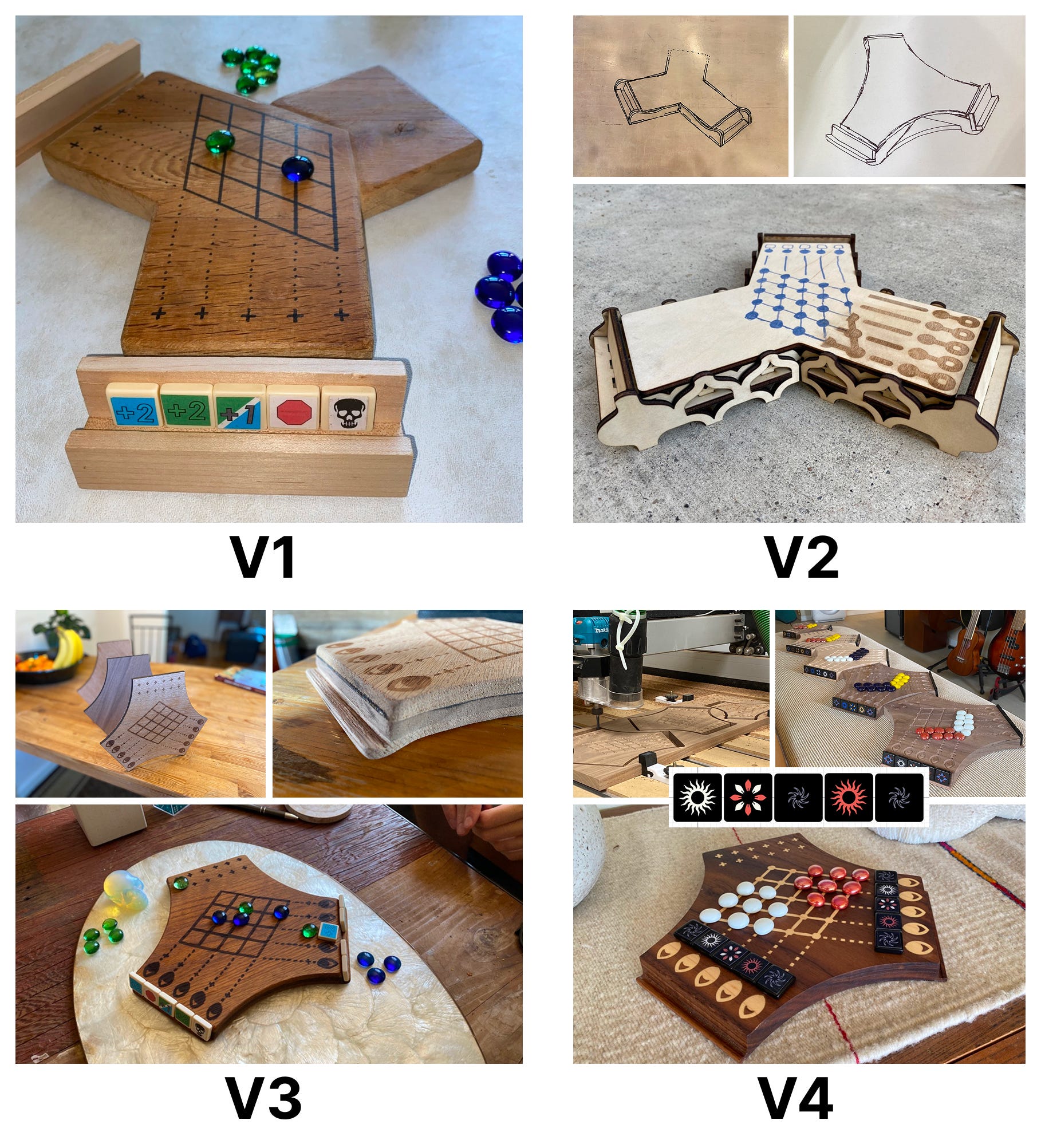
V3 introduced the signature curved board with integrated tile racks, plus an improved ruleset. V4 rounded out the aesthetics with new tile designs, stone colors, and naming conventions.
There are currently four V4 sets, plus one Mini Town (a smaller version of the game), making up the “V4 tournament collection” displayed below:
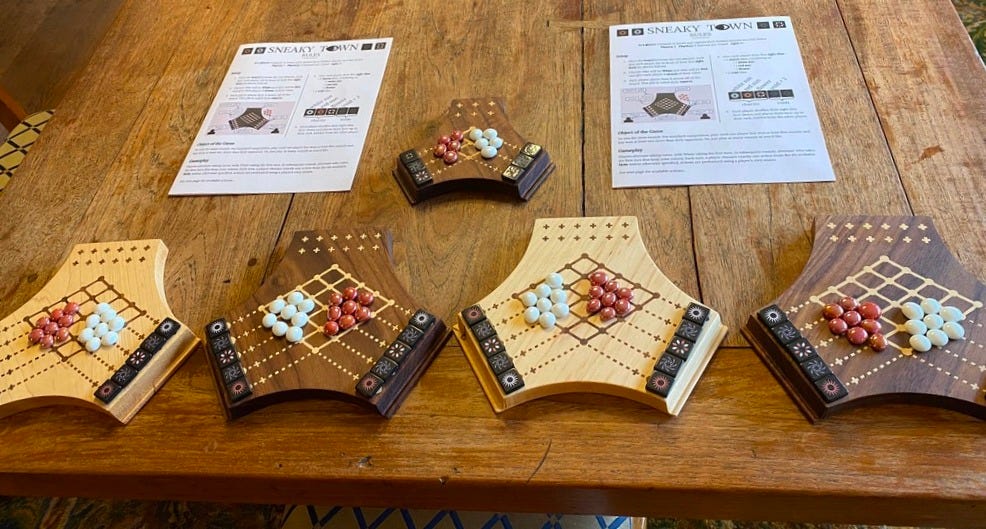
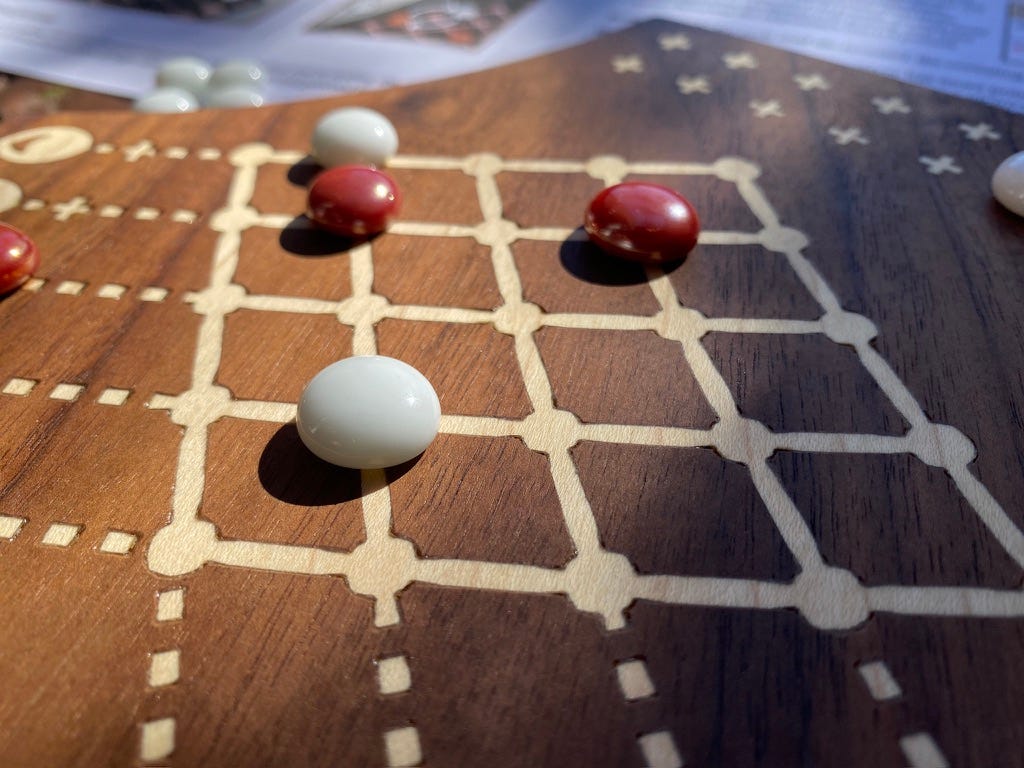
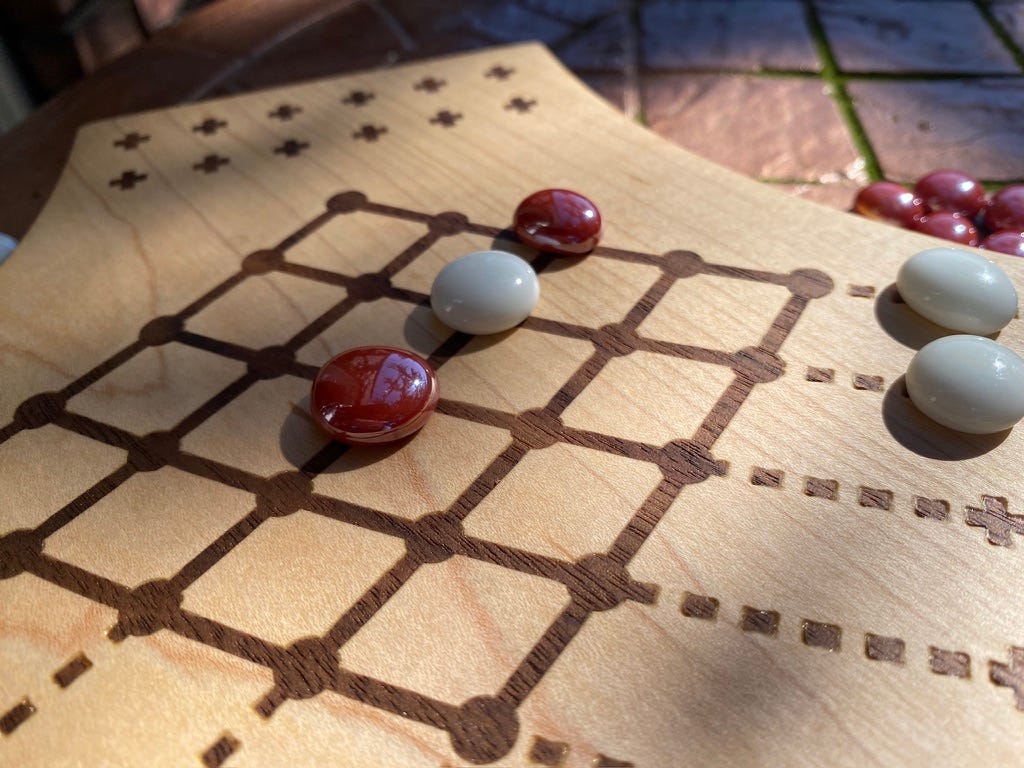
These boards are handmade with solid hardwoods: each is made of walnut with maple inlays or vice-versa:
I’ve also performed CNC machining for an additional 15 boards, the first of many steps in the manufacturing process. I am not actively working to complete those sets, but when the timing is right I will do so, bringing total circulation of Sneaky Towns to 20 (if we include the V3 board). In preparation for that development and future development I have archived the relevant design files and created a Sneaky Town manufacturing guide2.
How can I play?
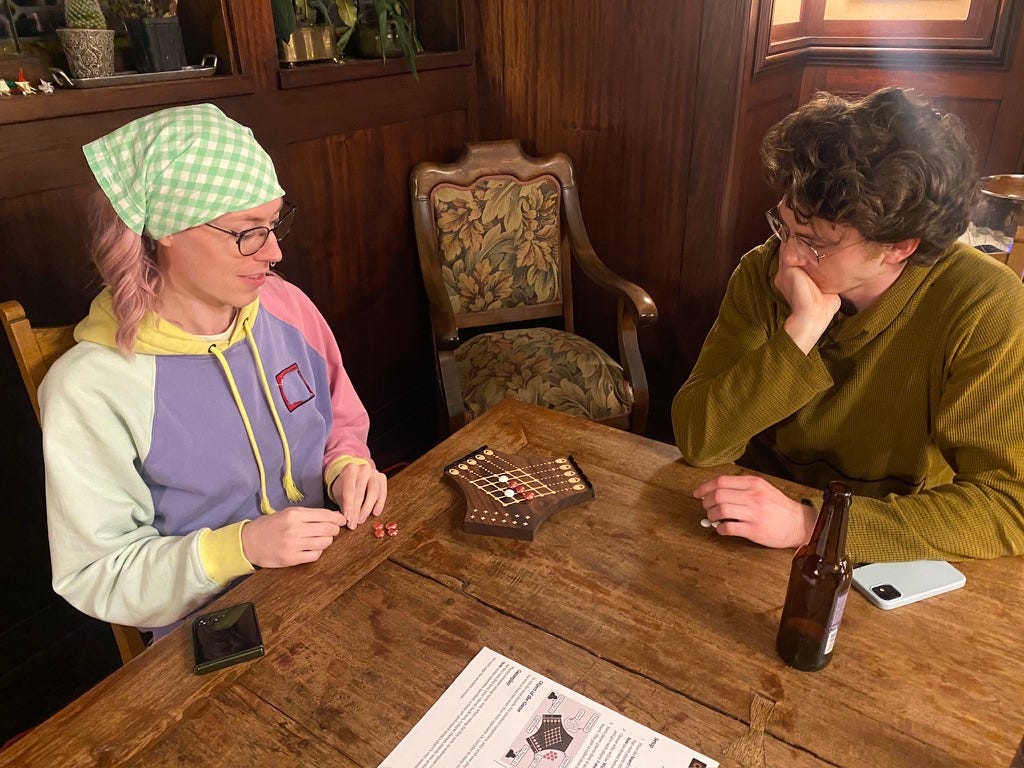
Sneaky Town is not currently for sale. The best way to play is to find me and ask me to play (currently in Oakland), or to attend a Sneaky Town event, like my upcoming event at The SF Commons (link).
Potential future developments
I am unlikely to openly sell sets anytime soon, and for now I don’t have plans to mass-produce3. If I do complete the additional 15 sets mentioned above then I may sell some, but my primary motive will be to get copies into the hand of select friends/spaces who would play a lot.
I am considering developing an online version at some point, though that project is subject to my availability. In general Sneaky Town has been, and I expect will remain, a side project that progresses slowly. For now I am happy to have five boards complete.
Cambio is known in my circles as “The Game.”
The manufacturing guide is not published, but if you’d like to make your own Sneaky Town feel free to reach out and I’d probably share it with you. I sorta doubt anyone would follow through as the process is quite time-consuming and expensive, requiring proficiency on the CNC router and access to other tools and materials.
…in part because I am unsure how to scale production without compromising on quality and/or paying for expensive bespoke woodworking (see footnote 2).