

- 1 -
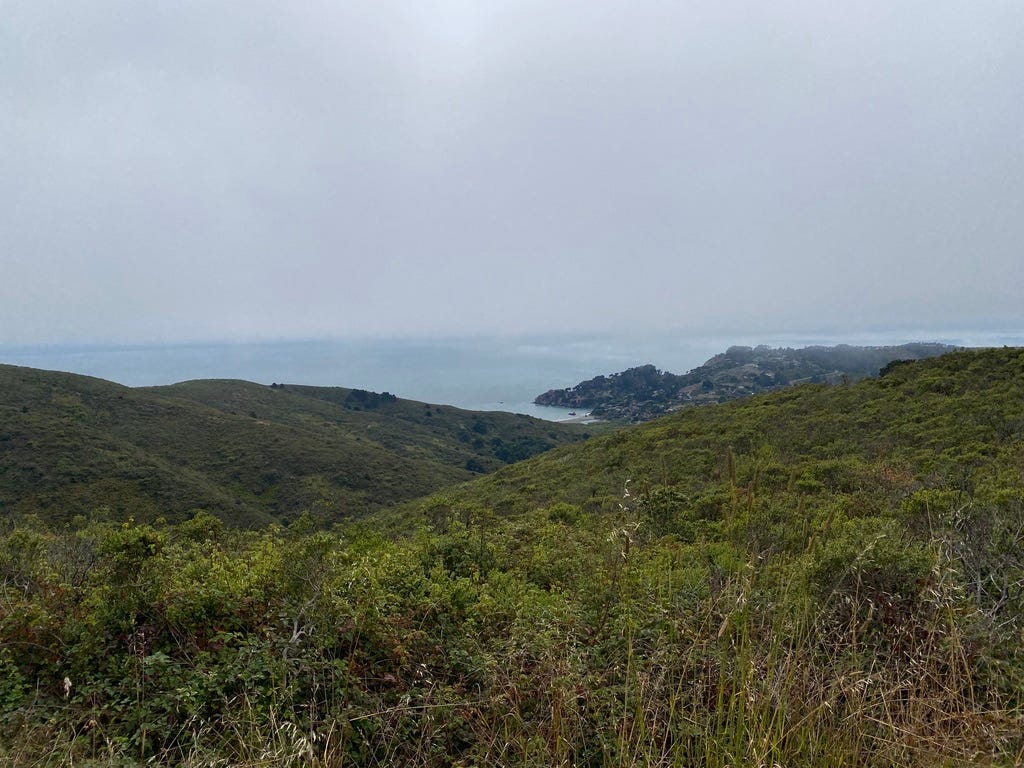
I was carrying too much stuff: books and a computer, as if I might write my next blog post atop the hill. But of course it was foggy and cold, and I barely scrawled a few sentences in my journal before stashing my backpack and setting off to run. I didn’t have much to write much anyways. My mind felt uncharacteristically blank, like the foggy landscape around me. I also forgot my headphones and was glad for the opportunity for a quiet run.
I saw the ocean far below, and I wasn’t sure how far down my trail would go but I worried about a steep ascent on the way back.
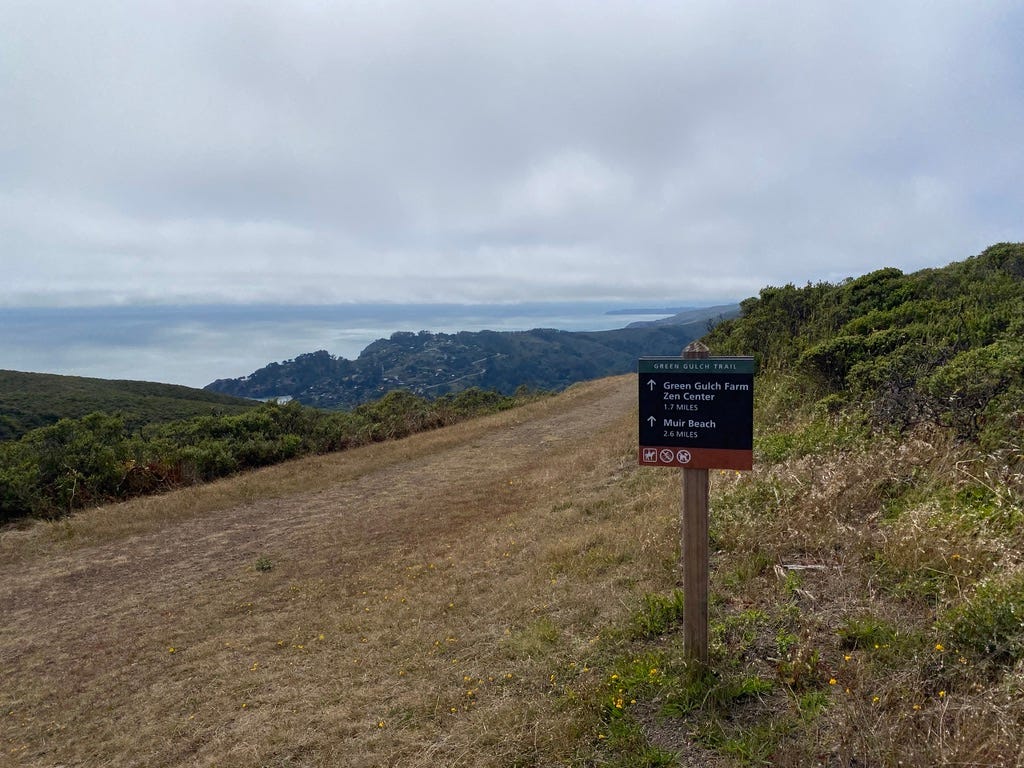
I soon came to a crossroads: “1.7 miles to the Green Gulch Farm Zen Center.” How strange for this business to have made it onto the regional park signage system, I thought. I was intrigued. I imagined myself arriving at a beautiful monastery with the door slightly ajar, a receptionist inside welcoming me to join the others on seated cushions. I headed that way, thinking “I hope this detour doesn’t add further elevation to my run.”
I reasoned that there were two outcomes: the detour could take me farther below my original route, thus extending my ascent, or it could act as merely a stop on the way down.
When I got to the zen center there was no receptionist and no group to join, just a quaint little dilapidated farm, so I continued onwards.
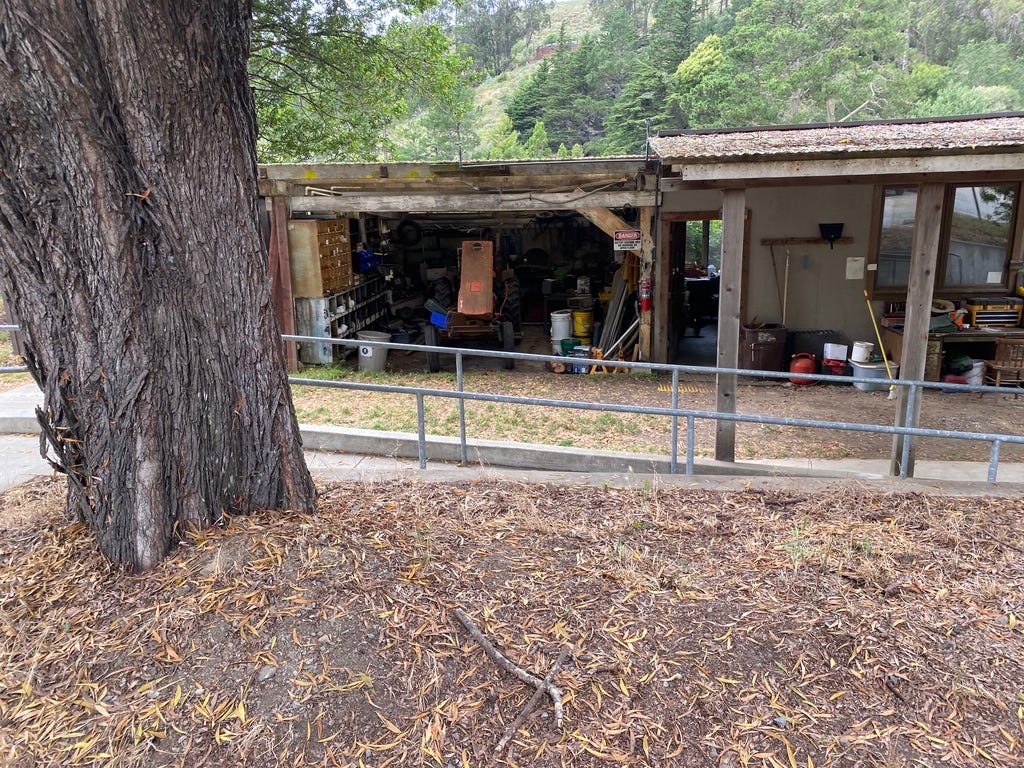
Upon leaving my path turned up the hill, indicating that my fears were confirmed — I had dropped below my original path and extended my ascent. I felt a flash of disappointment.
…
But that reaction makes no sense, right? Didn’t I want to conserve my energy? And leaving the zen center, wasn’t the best case scenario to begin ascending immediately towards home, not to continue further downwards? Why then was I disappointed?
I kept thinking about how strange my reaction had been. There must be some mindset, I thought, which would not be disappointed when the path began to ascend, and rather would be glad to learn I was able to make my way back as quickly as possible.
- 2 -
I haven’t written about my post-viral fatigue stuff recently, but things are going quite well! It’s not really a problem anymore and I go on runs like the above without thinking much of it. Which is great news.
I spoke to a young man who was inspired by my post to do his own experiment in pushing past his limits. We set up a phone call and discussed all the common strategies and difficulties we were facing as long-covid-recovery-adjacent folk.
At one point he asked, “do you now believe you could have recovered much earlier?” After all, it seems that I’d proven my symptoms to be surmountable. Maybe that had been the case for a long time?
My response was that:
Yes, maybe I could have recovered earlier. But:
There could have been a “true illness” that lasted for a long time, and it’s hard to say exactly how long that lasted: i.e. it’s hard to say at what point things became surmountable.
I did ramp up my exercise over a long time. Perhaps that was necessary.
The cost benefit analysis of the situation is truly difficult, given the potential risks of mistakenly pushing past a limit that I actually shouldn’t push past. So, the optimal path to recovery might be much slower than the fastest possible path (I’d argue that it often is).
I think that’s all true, but there’s another answer I could have given, which is, “I really don’t know, but the main thing that matters is that my current approach is working well.” Which I think is also a very good answer.
Still running? How's your fatigue?