

(being weekly post 5 of 52 in the year 2026)
I’ve been thinking about how I might cultivate “deep knowledge” in my career and/or life. This essay explains what I mean by that, and tells the stories of three people around me who have done so. These stories make up the second half of the post, and are about:
A Civic Entrepreneur
A Logician and Radical Behaviorist
A Computational Biologist
But first, my problem statement:
I am awash in a sea of concepts
Increasingly, I feel that I know less and less. The world is a complicated place and it’s getting more complicated. Just this week, Moltbook arrived, and suddenly, machines are writing human-like posts to each other on an (ostensibly) AI-only social network.
What are the implications? No one knows, really. Perhaps this is a fun experiment that goes nowhere, perhaps it is an awakening of a new hive mind that will soon dominate the world. Most likely, it is a currently harmless experiment that foreshadows a near future of increasingly confusing dynamics between humans and growingly empowered machine intelligences.
When I say “no one knows”, I’m including the researchers and engineers who built the language models that make up the most significant part of these agents’ internal workings. I know this because I follow them on Twitter and Substack and other places. There is a healthy debate ongoing about the trajectory of AI, with some believing that AI will show diminishing returns, growing to nothing more than a helpful assistant for well-scoped tasks, and others believing that autonomous software agents will eclipse humans in all capabilities. Beliefs about timelines for such outcomes vary widely.1
…
Additionally, in my own work I feel I know less and less. I write code in high-level languages, far from the actual binary operations of my machine. These languages shift in and out of fashion while I sit atop the current wave. And whereas I previously needed to memorize many programming language features, I now rely on LLMs to write most of my code for me. With the introduction of new flagship LLMs like Claude Opus 4.5, I find fewer errors in the code they generate and am incentivized to delegate larger tasks.
Beyond that, I spend a lot of time reading blogs and listening to podcasts, and though I’m occasionally inspired by these sources, I don’t feel they leave me with a much better understanding of the world. I feel that they leave me with a fashionable vocabulary that sits underneath a discordant pile of half-understood concepts. When I attempt to articulate informed beliefs on subjects about which I’m “well-blogged”, I surprise myself with my lack of understanding.
Towards deeper knowledge
I don’t doubt that my effectiveness at work and in other arenas of life is increasing over time, but I also don’t enjoy the feeling that I lack strong understandings of the world and my impact within it. I wish to do good, and to develop convictions about how to do so. In this rapidly changing world, such footholds seem hard to reach, and yet I maintain the belief that they’re reachable, and that doing so is a sure way to have a positive impact on my community and/or the world. I maintain that belief because I see confirming examples, sometimes in the people around me (more on that soon).
I’ll call what I’m looking for “deep knowledge.” What do I mean by that? Here’s a graph of how I’m thinking:
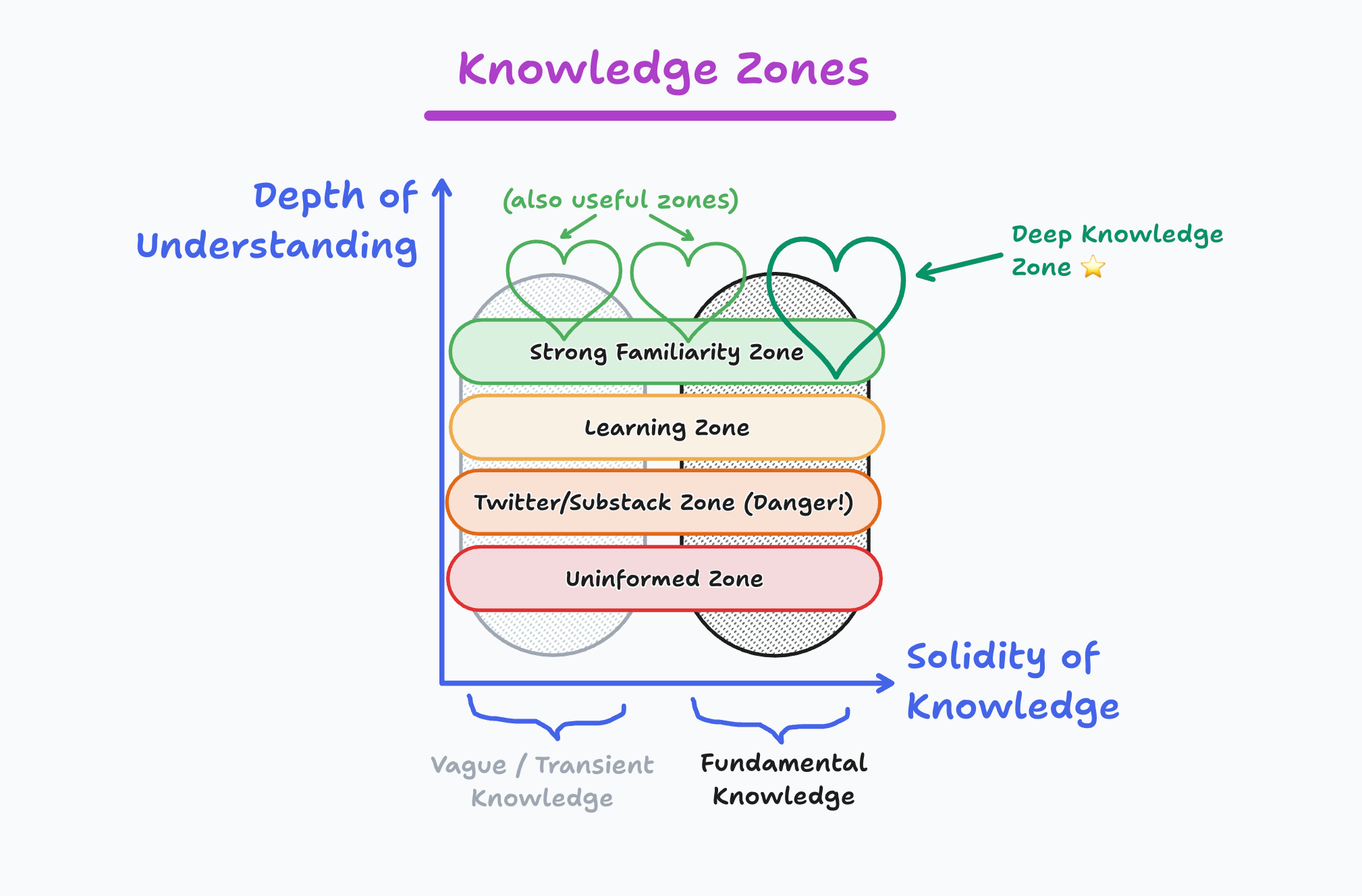
Here’s what you’re seeing above:
X Axis - “Solidity of knowledge”: Solidity could be broken down into sub-dimensions of transience and rigor. For example, knowledge about a particular US census might be rigorous but transient. Knowledge about Internal Family Systems might be less rigorous (no offense to IFS - just a bit of a fuzzier topic). Whereas knowledge of Newton’s laws of motion would be rigorous and perpetually applicable.
In truth, the concepts “transience” and “rigor” might not perfectly encompass what I wish to describe here, and I use “solidity” as a placeholder for some more calibrated term of judgement around knowledge’s applicability.
Y Axis - “Depth of understanding”: The bands here describe levels of understanding. Note the “Twitter/Substack Zone (Danger!),” which I lament earlier in this essay. To clarify, it is specifically the ambient-scrolling form of consumption (which I find myself doing all too often) that seems insufficient for deep understanding.
The top-right zone is the “Deep Knowledge Zone,” in which one has a deep understanding of a solid knowledge area, such that one can speak, write, and think well about it. But really the whole top row is a good place to be.
Stories of deep knowledge
I will speak of three people around me who have taken their own paths in the deep knowledge direction, each of whom inspires me in different ways.
Caveat: these stories are from memory, and only represent my own perspective
The civic entrepreneur

I met Daniel at my co-living house in Brooklyn. Along with his impassioned speeches about America’s founding fathers, I learned of his vocation as the founder of Maximum New York (MNY), a “civics academy focused on governmental mechanics.”
Daniel took his own learning very seriously on the way to becoming an instructor. He seeks to read five books on each subject before he considered himself to have a reasonable grasp of it, and he’s done so with many subjects. He studied each aspect of the government in granular detail, including such feats as memorizing the NYC charter and reading every local law passed in 2023.
On our “Knowledge Zones” graph: Daniel’s knowledge would be distributed around the top layer - he knows a great deal about a subject area (government & politics) that is itself sometimes amorphous. But, within that area, Daniel’s knowledge is about as fundamental and mechanistic as it gets, and that places him in a position to pursue impactful projects from a standpoint of intellectual rigor. I am super inspired by his work with MNY and his other political activities, all of which are oriented towards promoting the prosperity of New York City and its citizens.
On learning paths: Much of Daniel’s learning happened outside of the university - after graduating, he underwent a number of career pivots and personal projects that eventually led to his current direction, and along the way he pursued much of the learning (and especially learning by doing - engaging with his local political systems) that led to his current expertise. Daniel has also expressed disatisfaction with political science degrees.
The logician and radical behaviorist

I met John during my time in college and have since struck up a correspondence in which we discuss all kinds of topics, often adjacent to human behavior and computing.
John has read an impressive amount, and, like Daniel above, has the bookshelves to prove it. John’s areas of interest are wide, but they center around logic, math, and the science of human behavior.
On learning paths: John has a diverse educational past that involved study and research across many subjects (math, physics, cognitive science, computer science) at a few institutions. During his undergraduate years he honed in on math as a primary interest and met mentors (David R. Larson and Ronald G. Douglas) whom he cites as ongoing influences.
Eventually John dropped out of a math PhD program and continued to independently learn about the history of math, logic, and behavior. Over time, he developed a perspective and opinions on such fundamental questions as “what is truth?” and “how is science done?” and “how do people function?”
I asked John how long it would take for me to understand his worldview. “About a decade,” he said, once again sending me a picture of his bookshelves. But he admitted that there was a handful of books that most captured his worldview, and I got started reading one of them: “The Analysis of Behavior (Programmed Instruction).”
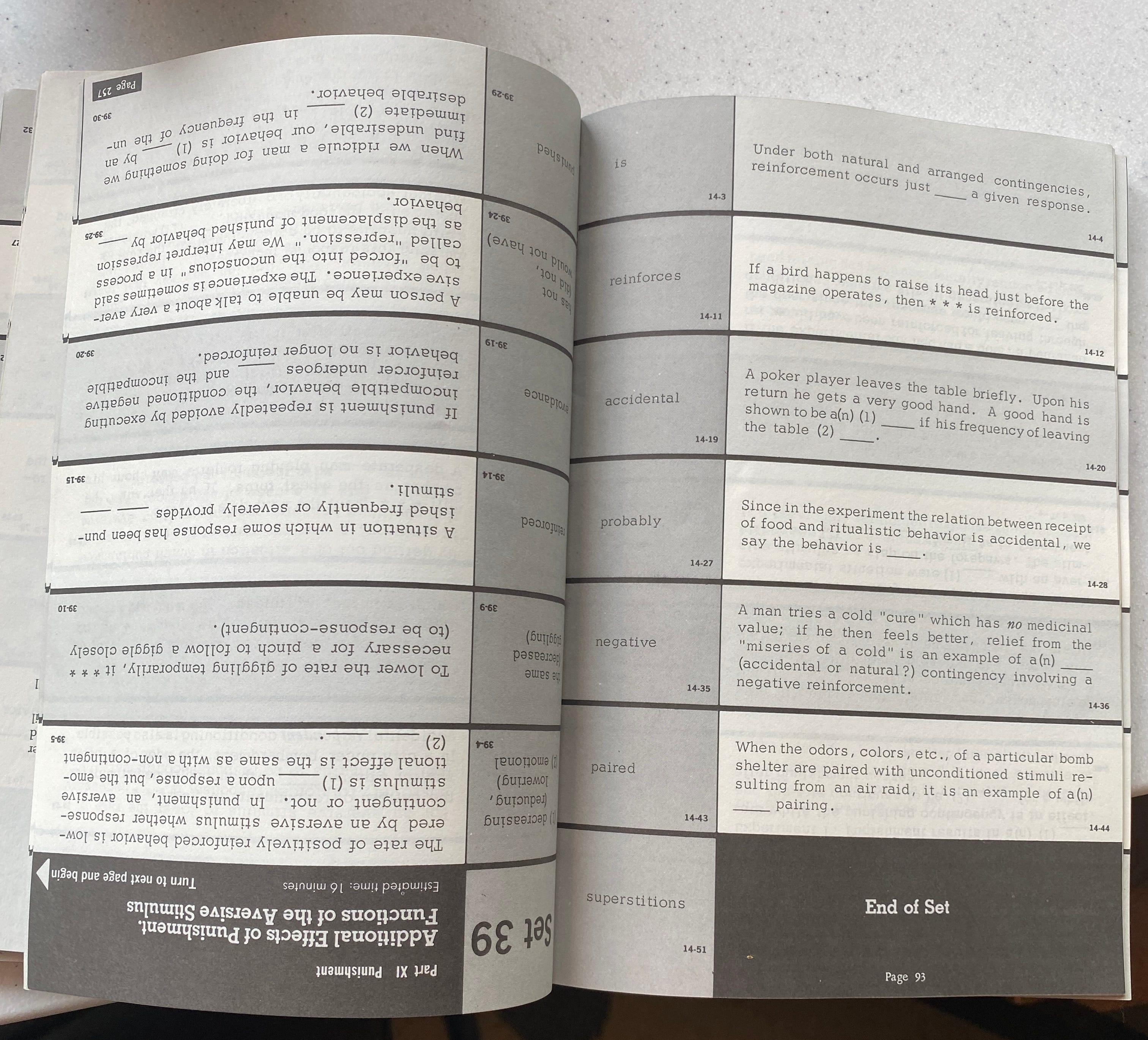
Reading this book is part of what inspired me to write this essay - it was a joyful experience to learn something very fundamental about our world, and to do so not by scanning blogs that I’ll soon forget, but by carefully engaging with a system of memorable facts and theories. For example, did you know that your body has three kinds of mechanisms for responding to its environment: striated muscles that move your skeleton around, smooth muscles that modulate the dimensions of internal organs, and glands that release various juices? What a basic thing that I was unaware of!
On our “Knowledge Zones” graph: John’s knowledge is clustered at the top right, being both solid and deeply understood. John is still in the early stages of applying this knowledge to the world, but he aims to contribute to the survival of what he sees as an atrophying culture of scientific rigor, in part by developing and sharing teaching materials related to science, logic, and behavior.
The computational biologist
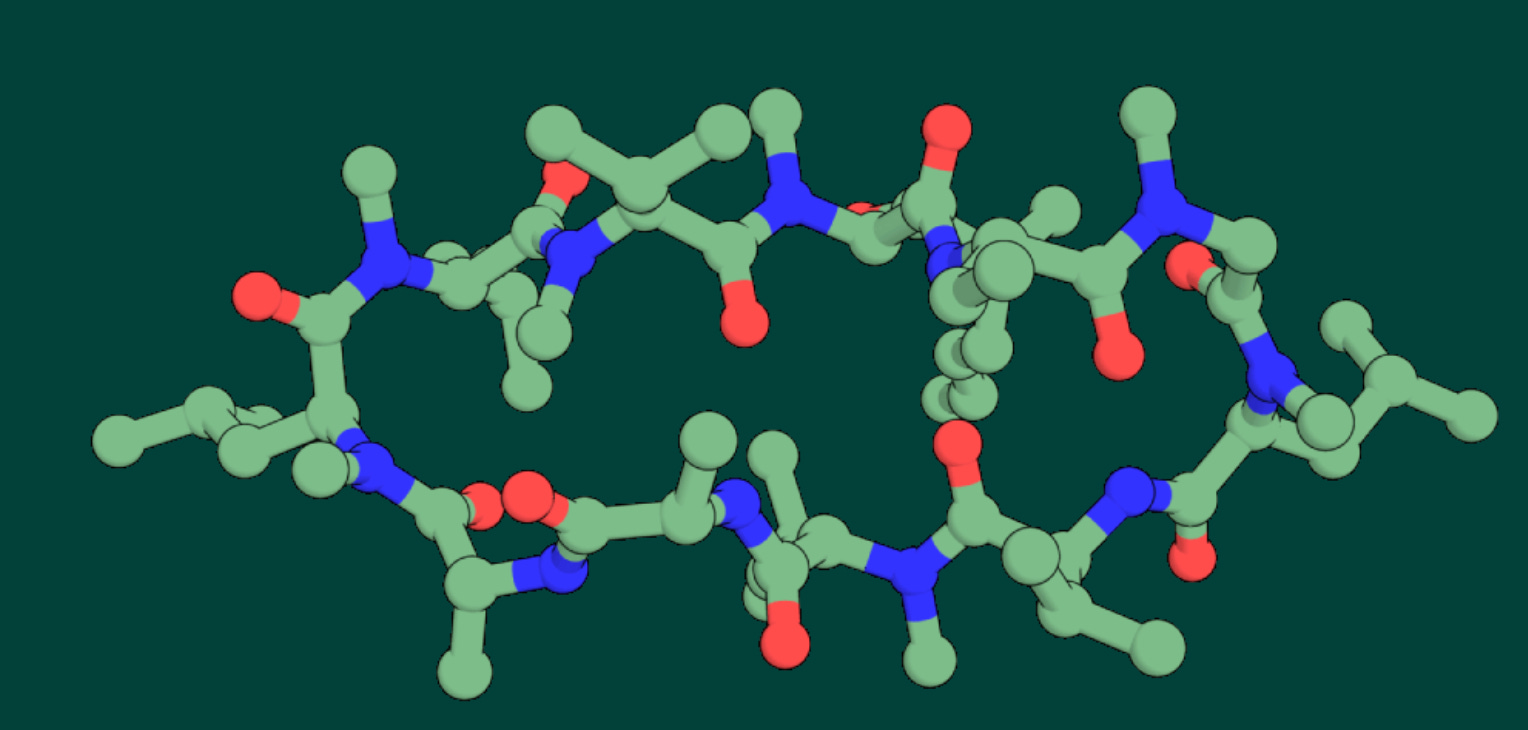
I got to see Pascal speak at my house’s “TED talk series.” He spoke for an hour plus about Vilya, a recently-trained neural network that can predict the structure of small cyclical molecules (macrocycles) with state-of-the-art accuracy (think of this like DeepMind’s AlphaFold, but for even smaller biochemical structures). Predicting these molecular structures can speed up the development of drugs that neutralize harmful proteins.
As with my reading of “The Analysis of Behavior,” I loved stepping into a world of more concrete truths. There’s something thrilling to me about looking at a chemical diagram and thinking “wow - this is very real, and very important, and I know very little about it, though much could be known.” And as with MNY, I am inspired by Vilya as an application of deep knowledge towards pressing problems.
On our “Knowledge Zones” graph: Vilya is a collaboration between biologists, chemists, and machine-learning engineers like Pascal, and Pascal’s own role required him to have knowledge of each subject. I believe his knowledge would occupy various x coordinates along the top of the graph, with biochemical knowledge being an especially solid component.
On learning paths: Pascal completed a computational biology PhD before joining Vilya. He considers himself to be lucky to have landed an excellent advisor and a personally-interesting research area with a high potential for impact.
So how does one get to deep knowledge?
There’s some overlap in these three stories. In all cases, the knowledge-acquirer was substantially interested in their field and spent at least a few years dedicated to learning. In all cases, this learning involved a high volume of book-reading and accompanying writing (whether for personal notes, publications, or assignments). At least in Daniel’s and John’s cases the curriculum involved both modern and historical texts. And at least in John’s and Pascal’s cases, the academic environment and key academic mentors were important parts of the picture.
Again, a big caveat - these are my own analyses! I would certainly benefit from asking these people more about their own perspectives on their learning journeys. But today it’s Wednesday, and the blog must go out.
…and how might I pursue deeper knowledge?
As to my own possible paths, I have a few open questions. One is “what to learn about?” I seem to have intrinsic interest in computation and planning (a la Methodable), and those interests point me towards the realms of AI agency (or human agency). There are also deeper directions to go when it comes to software engineering more broadly. However, these directions feel less solid when compared to e.g. biology. I actually feel excited about computational biology presently for that reason, though this is a recent interest, and I don’t know much biology yet.
The second open question would be how to approach such learning, in case I’d like to do so. The academic route is appealing, as higher ed is our primary institution for the development of deep knowledge. But I worry about ending up in the wrong lab and studying something that is not personally interesting or applicable to real-world problems. So on reflection, a key sub-question is: “how easy is it to pivot and choose your own research direction in various academic settings?” - If the answer is “very” then that seems a promising direction.
On the flip side, I seem to be surrounded by a culture of DIY learners, some of whom have indeed gone very deep in their subject areas. Considering such approaches in my own life raises further questions: how would I find/create a community of learners and support myself through a learning period? How would I maintain clarity on a learning path?
If anyone has thoughts or related experiences to share, I’d love to hear from you.
Til next time,
Daniel
My current views on AI futures fall somewhere around “AI will be a huge deal, will probably mature within my lifetime to the point of pursuing goals more effectively than humans (with all the consequences of that fact), but that would require significant research advances that may be decades away. Regardless, we may see serious near-term societal effects, and possibly near-term significant jumps in capabilities as well.” But I won’t argue any of those points in this piece, and my views are mostly an aggregation of the beliefs of others who are closer to the action.
As a Psychologist, I’m fascinated by your post. You share interesting questions and, in kind, I’ll add a few - because the answer to your quest is only yours.
First question: what’s behind your interest in deep knowledge? I do believe that knowledge is never fully achieved. Meaningful learning can be a more fulfilling journey, and I find it more practical. Sure, knowledge is a valuable foundation, yet when transformed into active learning it often takes us to unanticipated places.
To your question of what to focus on, I’d ask “where do you want to start?” Another belief of mine is that we start somewhere and see where it leads us. “What is your curiosity about?” Knowledge can also be like a big bookshelf with lots of different topics. And the broader the variety, the stronger the connections we make in our brains.
Third, you’re weighing DYI and academic pursuits. My question to you would be about purpose and who you’re aspiring to be. In my own experience, no learning I’ve gained has gone wasted, even if it took me years to see it bear fruit. Learning bears fruit when we engage in reflection and action, and that can happen no matter what learning vehicle we use.
Anyway, I loved this post and I keep getting inspired weekly by your deeply human writing.