

(being weekly post 9 of 52 in the year 2026)
Today we return to a core story of my life: that of my living personal systems. I’ve previously touched on them, but only in vague terms. This post will provide a more complete story, starting with my initial inspiration and ending with the launch of my first set of self-reflective routines.
I’m excited to share about these systems in part because they form the missing link between many disparate topics that I’ve written about, such as human-programming tools, artificial general intelligence, routines, and personal growth (links are to past posts).
Consider this part one of The History of My Living Systems. The full story would trace a thrilling rise and tragic fall, as the systems that survive today are a shadow of their former glory. And yet, I wouldn’t be writing this if I didn’t believe in the continued value of the endeavor, at least in my own life.
In any case, our story begins with a moment of inspiration.
A moment of inspiration
To set the scene, towards the end of high-school things were going great for me - I was enjoying school, getting lots of physical activity, and spending time with friends and family. But also I was feeling a growing sense of unease. A few things felt true: firstly, that the world was full of great opportunities. Secondly, that I had been “going with the flow” - working diligently at the tasks put in front of me (mainly school), but thinking little about what was actually worth doing with my life.
These feelings had been bothering me for a while when inspiration struck from an unlikely place: the psychological-thriller film Memento. In Memento, main character Leonard Shelby can’t form new memories, and yet is determined to accomplish a goal that he developed after his memory left him. His solution is to create a series of prompts, many of which are tattooed onto his body, that would remind him of his mission and the reasons behind it.

I had no intention of getting such tattoos, nor of pursuing such a vengeful mission, and yet I was inspired. Here’s someone that knows what he’s doing and why he’s doing it, I thought. And crucial to my inspiration was Shelby’s approach: he created systems that directed his attention and efforts towards his most important goals. To be clear, this is not a “Top 10 Life Optimization Tips I Learned from Christopher Nolan’s Memento” post - I barely even remember the plot, and am certain that my own systems diverged strongly from what’s depicted in terms of both vibe and approach - but, I cannot deny the inspiration!
I imagined having my own set of core directives, not tattooed onto my chest, but instead living in some digital or physical notebook that I could reference regularly. However, unlike Shelby, I didn’t have some totalizing quest handed down to me by the screenwriting gods, so I would need to figure out what I wished to do before attempting to do it. I began to imagine how I might go about discovering my values.
Planting the autopoietic seed
I might have sat down and defined some values for myself. But I figured that arriving at my values would be a longer process. And so, I might have sat down and defined the process for arriving at my values. But I figured that arriving at the process for arriving at my values would be a longer process. And so, I might have sat down and defined the process for arriving at the process for arriving at my values, but I figured that arriving at the process for arriving at the process for arriving at my values would be a longer process (and so on…)
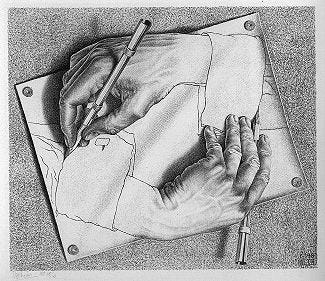
It was clear to me that I was seeking a generic system that could grow in complexity over time while adapting itself continuously to my needs. I was still inspired to create finer-grained directives / principles for myself, but I didn’t want to start there. I wanted to build the adaptive foundation on which those directives, and any other system that might serve me, would stand.
Long after I started, I learned the term autopoietic1, meaning “capable of producing and maintaining itself by creating its own parts.” The term has been used to describe the self-maintaining chemistry of living cells, and it captures the “living” qualities of the system I wished to produce.2
A foundation of reflection
The simplest foundation I could imagine was to create daily and weekly routines that compelled me to reflect, and through that reflection to modify my routines to better serve my aims. I imagined these routines forming the seed that would blossom into more expansive systems for self-guidance.
I defined the following initial program for myself:
Complete the following activities without fail.
Daily: Write in your journal about how your day went and any thoughts you have about how to live your life better.
Weekly: Review last week’s journal entries, then update this reflection program in order to improve this program’s ability to achieve its goal: to help you lead a good life.
…And then I got to it - I purchased a journal and committed myself to daily nocturnal reflections, and from that point on the system took over.
This act of creation was quite a rush for me. I felt that I was starting a new life, both for the system and for myself. From now on, everything I do has a purpose, I felt. Now that I am committed to this program, all of my actions are contributive towards leading a good life. I felt I was embarking on the project of a lifetime - a project to systematically transform into the kind of person I wanted to be. All of my creative energy was happily directed towards this new pursuit.
…
And then the system began to grow. In the next post in the series I’ll continue the story, describing the specific results that emerged from these earlier foundations.
I don’t actually know whether you can adjective autopoiesis, and if so whether it adjectives into autopoetic or autopoietic. Both spellings show up on the internet, though references are few. In my search I did find autopoetic.ai, “A foundational AI and consensus R&D company.” I didn’t read their whole white paper, but skimmed it. They make some wild claims, which I share below, mostly because I’m pleased that my search for words to describe my projects takes me in interesting directions…
We believe Minary is a candidate for the first formally proven autopoietic computational primitive. We acknowledge the weight of this claim and hope that this article prompts discussion and new directions of inquiry.
The properties of autopoiesis: self-maintenance, coherence through feedback, and structural stability, suggest new possibilities for computational systems. Where traditional allopoietic architectures require external intervention to maintain function or adapt to new conditions, an autopoietic primitive could enable systems that are robust to component failure, adaptive without retraining, and capable of operating in environments without ground truth. The linearity and commutative properties of Minary’s superposition additionally provide computational advantages: O(n) complexity, natural parallelization, and suitability for distributed architectures. And perhaps most the intriguing property of all: Minary possesses uniquely relative learning dynamics that support what could be a form of a purely relative, subjective, identity.
To draw a connection to one of my recent posts, in How I Used Methodable to Have a Nice Tuesday I shared a (very) detailed story of a personal program which exhibits aspects of the overarching personal systems I discuss above. The story follows a day in my life…
[…] starting from when I awoke and continuing through the creation of a seed program which ultimately blossomed into a comprehensive, tailored guide for my day.
The story then describes the pattern of unfolding (via meta-planning) that allowed my initially small program to build itself into something greater.
But, my Methodable program on that day was not fully autopoietic - it did not maintain itself, rather it blossomed and died on the same day. We could say that program exhibited allopoiesis instead:
Allopoiesis is the process whereby a system produces something other than the system itself. One example of this is an assembly line, where the final product (such as a car) is distinct from the machines doing the producing.
So the meta-plan described in that prior essay was like an assembly line for producing other plans (or meta-plans), but which did not ultimately reach around and re-assemble itself. Whereas, the seed program for my personal systems did actually wrap around and modify itself, and that’s how it could extend its relevance indefinitely into the future.
Cool! I’m curious to read your next post about results. I’m also curious about how this system shapes progress, and by shape, I mean the geometric shape of progress. Like, if the system is something that builds from one week to the next in a linear? manner, is the personal growth that results also linear? Idk if that makes sense